
Khomeini's War on the West
Iran didn’t escalate into war with Israel and the West. It was born at war with both — and spent 46 years building the arsenal to prove it.

We thank Uri once more for bringing the truth into full view; his illuminating take on the current conflagration in the Middle East is required reading. Or is it current? Perhaps it was promised from the birth of Khomeini’s hellish regime. Perhaps this war was always planned to be.
If one has serious pretensions of understanding Iranian policy and the nature of its Islamist regime, you are obliged to engage deeply with this text. Uri builds a painstaking case that exposes the Khomeini ideology —and the Western complicity that has brought us to a war 46 years in the making.
In other news, the latest chapter of Uri’s Rooted Truth will be coming out later this week for paid subscribers of Guerre and Shalom. Meanwhile paid subscribers of Israel Brief will soon be treated to a serialisation of my very own Pax Arabica. This collaboration allows paid subscribers of either publication to get double their value for money.
Finally, anyone who believes their own book to be of sufficient quality to be serialised on this platform should DM me directly. In the meantime, I will leave you to read, like and spread Uri’s essential analysis. - Daniel Clarke-Serret (editor)
“The Promised War” by Uri Zehavi
Iran didn’t escalate into war with Israel and the West. It was born at war with both — and spent 46 years building the arsenal to prove it
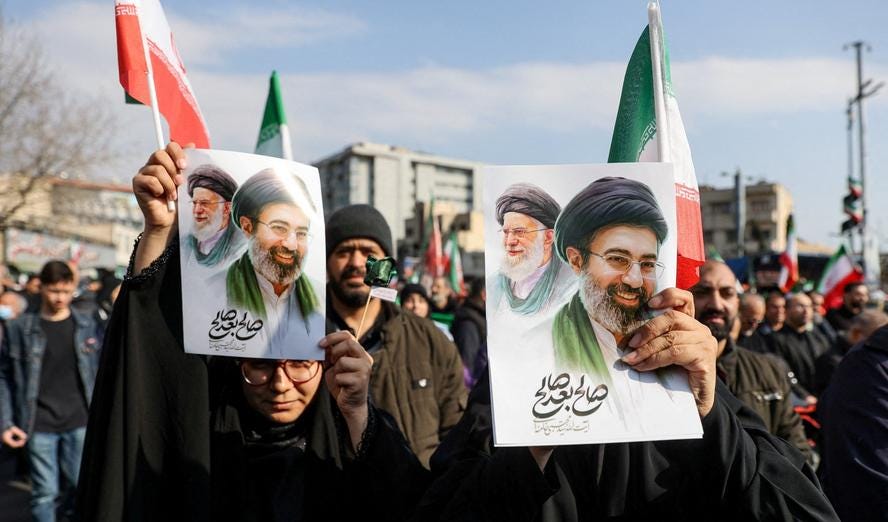
On August 7, 1979 — six months after the Shah fled Tehran and three months after Ayatollah Khomeini established the Islamic Revolutionary Guard Corps by decree — Khomeini announced the creation of Jerusalem Day. Every last Friday of Ramadan, the faithful would march for the destruction of Israel. He called it a religious duty. He issued a fatwa declaring the elimination of the “Zionist entity” incumbent on every Muslim. He designated Israel the “Little Satan” and the United States the “Great Satan.” He meant all of it.
That was 46 years ago. Not a generation — a strategic lifetime. The regime built an army to prosecute the declaration, a constitution to enshrine it, a network of proxy franchises from Beirut to Sana’a to deliver it, and — when the West offered economic appeasement instead of confrontation — a nuclear program to guarantee it. What CNN and others call the “Iran crisis” and diplomats frame as a “regional escalation” is the fulfillment of a promise made before many of today’s policymakers were born.
The war between Iran and Israel did not begin on October 7th. Nor last summer. Nor even the 28th of February this year. It began in the first weeks of the Islamic Republic, with the ink still wet on Khomeini’s founding decrees, and it has not paused since.
Within days of the revolution’s triumph, Yasser Arafat became the first foreign political figure to visit Tehran. The former Israeli embassy was handed to the PLO. The IRGC was already standing. Quds Day was already declared. And the constitution was being drafted with a clause committing the state to exporting the revolution across the globe. Everything since — Hezbollah, Hamas, the Houthis, the nuclear program, the proxy wars, the 608 dead American soldiers in Iraq, the missiles falling on Israel today — is logistics. The decision was made in 1979.
Islamism Declared War Before Iran Fired a Shot
Islamism is a totalitarian political doctrine with a god attached. Ignoring the political doctrine is the foundational analytical error that has crippled Western policy toward Iran for decades, and the Iranian regime exploits that confusion every time a critic is accused of bigotry for naming the political project by its actual name.
The intellectual architecture predates Iran’s revolution by decades. Sayyid Qutb, the Egyptian theorist executed by Nasser’s government in 1966, gave name to the framework in Milestones — a manifesto that divided the world between authentic Muslim governance and jahiliyya, the state of pre-Islamic ignorance that Qutb applied to every existing society, including Muslim-majority ones.
The prescription was revolutionary: a vanguard must seize the state, impose sharia, and expand. Not reform. Not proselytize. Seize and expand. Abul A’la Maududi, writing as early as 1926, articulated Islam as “a revolutionary ideology and program which seeks to alter the social order of the whole world.” Academic analysis classifies this doctrine as structurally analogous to Marxism and National Socialism — a totalitarian ideology that frames history as a cosmic struggle demanding total societal transformation. Christian Democracy participates in secular governance. Religious Zionism operates within a democratic state. Islamism rejects both models — the state exists to serve the ideology, and any state that does not serve its ideology is a target for revolutionary overthrow.
Khomeini took the Sunni Islamist blueprint and built a Shia state around it. His 1970 treatise Islamic Government argued that governance must be run under sharia by a supreme jurisprudent — the faqih — and that such governance could not be confined to one country. The divine mandate recognized no borders.
When the revolution succeeded in February 1979, the theory became law with astonishing speed. The 1979 Iranian Constitution, approved by referendum that December, committed the state to the “continuation of the revolution both inside and outside the country.” Article 154 bound the Islamic Republic to support “the just struggles of the oppressed against the tyrants in every corner of the globe.” This was not aspirational language buried in a preamble. It was — and remains — the operating charter of the state. The doctrine of velayat-e faqih does not recognize geographic borders. It constitutionally endorses transnational expansion as a religious obligation.
The institutions followed the charter at a pace that should have alarmed every Western intelligence service. The IRGC was established in May 1979 — less than three months after the revolution — with a mandate distinct from the regular army: the Artesh defends Iranian territory. The IRGC defends the revolution. It reports directly to the Supreme Leader, not the elected president. And, remember, that revolution… not limited to Iranian territory.
Quds Day followed on August 7. The hostage crisis began on November 4 — an act that was simultaneously ideological statement, strategic provocation, and domestic consolidation. Khomeini used it to order the creation of a twenty-million-strong civilian army. The students who stormed the embassy were the revolution in action, demonstrating to the world that the Islamic Republic recognized no diplomatic convention, no sovereign immunity, no international norm that conflicted with the ideological project. The revolution had been alive for nine months, and the regime had already built the guard force, declared the enemy, seized foreign hostages, and demonstrated that it would act without constraint.
Khomeini’s declaration…
We shall export our revolution to the whole world. Until the cry ‘There is no God but God’ resounds over the whole world, there will be struggle.
…was not performancative rhetoric. A speech analysis by the Tony Blair Institute examining seven Iranian leaders from 1979 to 2018 found that 100% of Khomeini’s speeches described the revolution as “Islamic” rather than “Iranian.” The state serves the revolution, not the reverse. Khamenei discussed exporting the revolution in 80% of the analyzed speeches. The language has been consistent for 46 years because the commitment has been consistent for 46 years.
The apologist line — that Iran’s constitution merely offers moral support to the oppressed — collapses under the weight of the text itself. Articles 152 and 154, and Khomeini’s own founding statement: “We must topple these unjust governments.” The Quds Force exists because the constitution requires it. The proxy network exists because the Quds Force requires it. The war exists because the ideology demands it. Everything after 1979 is its execution.

How the IRGC Turned Ideology Into a Proxy Empire
The IRGC is an ideological organization that acquired military capability — not the reverse. Understanding this distinction is the difference between treating the current war as a series of tactical escalations and recognizing it as the delivery phase of a strategic program that has been under construction since the revolution’s first year.
The Quds Force predecessor — the “Liberation Movements Unit” — had an explicit mandate. That was to provide military assistance to “Islamic liberation movements” abroad. That was folded into the Quds Force. By June 1982, the IRGC had deployed 1,500 Revolutionary Guard commandos to Lebanon’s Beqaa Valley to fight Israel and to train what would become Hezbollah. That deployment — less than three years after the revolution — was the first physical projection of the constitutional commitment into another sovereign nation’s territory.
The Quds Force was formally constituted in 1988 after the Iran-Iraq War. Qassem Soleimani took command in 1998 and spent two plus decades transforming a clandestine support network into the most effective state-sponsored proxy architecture in modern warfare — until a US Reaper drone abruptly ended his career at Baghdad International Airport in 2020. His successor, Esmail Qaani, inherited a machine that no longer depended on any single operator.
The architecture is a franchise model engineered for redundancy. Iran does not simply arm proxies — it transfers blueprints, parts, and production techniques so proxies can manufacture locally, creating operational independence and deniability simultaneously. If a weapons shipment is intercepted, the factory remains. If a commander is eliminated, the production line continues.
The funding is industrial-scale. Consensus estimates put Iran’s annual proxy upwards of $2 billion, though independent estimates that include broader regional operations range to $6–12 billion. Hezbollah receives an estimated $700 million to $1 billion per year. Hezbollah leader (at the time) Hassan Nasrallah admitted in 2016 that the entirety of Hezbollah’s budget, weapons, and rockets come from Iran. Hamas drew up to $300 million annually by 2008; the State Department estimated $100 million per year to Palestinian groups as of 2018. Houthi funding runs $100–200 million annually. Iraqi Shia militias draw $1–2 billion. The State Department estimated Iran spent over $16 billion supporting the Assad regime and its proxies between 2012 and 2020 alone.
Where does the money come from? Partly the state budget. Partly an economic empire that operates outside it. The IRGC controls an estimated $30–50 billion in annual economic turnover through construction, oil, telecommunications, and infrastructure. These are off-budget revenue streams that no sanctions regime has fully disrupted — because the IRGC is a conglomerate. And its economic activity feeds the proxy architecture without passing through any line item a Western auditor could easily flag.
As recently as May 2024, IRGC and Quds Force commanders met with Hamas and Hezbollah leaders in Tehran, affirming “continued struggle” as the regime’s top priority. In December 2025, Israel revealed a network of Hamas money-exchange houses in Turkey facilitating Iranian funding in the hundreds of millions of dollars.
The result, by the eve of October 7, was a “ring of fire” — the IRGC’s own doctrine of “unity of arenas” made physical. Hezbollah with 150,000-plus rockets and 30,000–50,000 fighters on Israel’s northern border — the most heavily armed non-state actor in the world, built over four decades from those first 1,500 commandos in the Beqaa Valley.
Hamas embedded in Gaza with a tunnel network that took a decade to build, funded by bothIranian money laundered through Turkish exchange houses and Qatari intermediaries and Western tax revenues. Palestinian Islamic Jihad operating as an IRGC franchise inside Judea and Samaria — smaller, less politically encumbered than Hamas, and more directly responsive to Quds Force command.
Houthi forces capable of shutting down Red Sea shipping with Iranian missiles and targeting data, a franchise that went from impoverished tribal militia to strategic maritime threat in under a decade of Iranian investment. Iraqi Shia militias — Kata’ib Hezbollah, Asa’ib Ahl al-Haq, and others — positioned to strike US forces across the region at a command from Tehran.
Every front activates in coordination, stretching Israeli and American defenses across multiple theaters simultaneously. The proxy empire is a single military architecture with one command authority — the Supreme Leader — one strategic doctrine, and one objective embedded in the constitution of the state that built it. As of February 28th, it was thrust into disarray, but continues to operate.

Israel Was Always the Target
Iran’s war against Israel is not a territorial dispute. It is not a response to Israeli policy in Judea and Samaria. It is not rooted in the Palestinian question. It is a structural requirement of the Islamist project — which needs an external enemy to justify domestic repression, legitimize transnational expansion, and sustain the revolutionary narrative that keeps the regime alive.
Before 1979, Iran and Israel maintained three decades of close cooperation. Iran was the second Muslim-majority country to recognize Israel, in 1950. The Shah encouraged Israeli advisors across military, agricultural, and construction sectors. Iran supplied up to 60% of Israel’s oil through the Eilat-Ashkelon pipeline. El Al operated direct Tehran–Tel Aviv flights. A joint missile development effort — Project Flower — ran from 1977 to 1979. SAVAK, the Shah’s intelligence service, was partly trained by Mossad. A Shia-majority, non-Arab state had no territorial grievance, no historical claim, no organic hostility toward the Jewish state. The relationship was deep, functional, and mutually beneficial.
The revolution destroyed it overnight. To be clear, not because of anything Israel did. But simply because the ideology required it.
Within days, Arafat arrived in Tehran as the first foreign political figure to visit the new regime. The Israeli embassy was handed to the PLO. Diplomatic relations were severed. Khomeini designated Israel the “Little Satan” and called it a “cancerous tumor” that must be excised. Khamenei continued the line in 2015, declaring Israel would not exist in 25 years. A digital countdown clock was unveiled in Tehran’s Palestine Square in 2017. I’m not sure what time change Operation Epic Fury caused it, but let’s assume it’s at least been reset.
The “Palestinian cause” is the regime’s preferred packaging for Western audiences. The contents are something else entirely. MEMRI’s analysis of Iranian Quds Day statements found that regime officials barely mention Palestinian welfare — the rhetoric centers on the Islamic Revolution’s goals and Iranian-Shia hegemony.
Palestinians are instruments, not beneficiaries. Khomeini’s motto — “The way to Jerusalem passes through Karbala” — reveals the priority hierarchy. The only real objective is Iranian-Shia dominance over regions under Sunni hegemony, with Palestine as the rhetorical vehicle that makes the campaign legible to Western sympathizers. When Iran funds Hamas, it funds a proxy that serves Iranian strategic depth in Gaza. When it claims to champion Palestinian rights, it deploys a narrative that Western audiences find sympathetic and Iranian dissidents find irrelevant. The gap between the two tells you everything about how seriously the regime takes Palestinian statehood as an end in itself [which is to say: not at all].
The eliminationist antisemitism embedded in the regime’s posture goes deeper than geopolitical calculation. Khomeini’s fatwa declaring Israel’s destruction a religious obligation drew on a tradition within Islamist thought — present in both Qutb and Khomeini’s own writings — that treats Jewish sovereignty as an affront to the divine order. Not Israeli policy. Not borders. Not settlements. Jewish sovereignty itself.
The “Little Satan” formulation is not incidental — it positions Israel as a demonic presence in the Islamist cosmology. A spiritual contaminant that must be eradicated as a precondition for the ultimate triumph of the revolution. That dispute cannot be resolved by negotiation. You cannot offer territorial concessions to an ideology that rejects your right to exist as a theological principle. Treating it as a “conflict” between two parties with competing but equally legitimate claims is the analytical equivalent of calling arson a “heating disagreement.”

America Is Not an Ally in Someone Else’s War, It Is a Co-Target in the Same One
The “Great Satan” designation is, likewise, a constitutional commitment backed by a 46-year body count. And the Americans who want to know why this war is their problem? They ought to start by counting their dead.
The Iranian regime has killed more Americans than any other state sponsor of terrorism since 1979. Here’s a non comprehensive catalog of that timeline:
April 1983: a Hezbollah truck bomb destroyed the US Embassy in Beirut — 63 killed, 17 Americans.
October 1983: another truck bomb hit the Marine barracks at Beirut International Airport — 241 US service members killed, the deadliest single-day loss for the Marines since Iwo Jima. Declassified intelligence shows the attack was carried out at Iran’s direct command — US intelligence intercepted an Iranian directive on September 26, 1983, instructing Iran’s ambassador in Damascus to order the strike.
June 1996: Khobar Towers in Saudi Arabia — 19 US airmen killed.
2003 to 2011: Iranian-supplied explosively formed penetrators and militia support killed at least 608 US troops in Iraq, accounting for 17% of US deaths in-country during that period.
January 2020: Iran fired 16 ballistic missiles directly at Al Asad Air Base and Erbil — 110 US troops suffered traumatic brain injury.
January 2024: Tower 22 in Jordan — three US soldiers killed, 47 injured.
Since October 2023, Iranian proxies have launched over 200 attacks on US forces in Iraq, Syria, and Jordan.
As of March 2026, at least seven additional US service members have been killed in the current hostilities.
A CIA assessment from 1987 reported that Iranian leaders viewed the US withdrawal from Beirut as proof that “terrorism can break U.S. resolve.” Bin Laden later cited the same precedent when he planned his own campaign against American targets. The lesson the regime drew from 1983 has never been revised — and every subsequent American retreat, de-escalation, or diplomatic accommodation has reinforced it. The Islamic Republic learned in its fifth year that killing Americans works. Nothing in the 41 years since has taught it otherwise. Well, that is, until two and half weeks ago (and to a lesser extent, last summer).
The strategic interests extend beyond the body count — though the body count should be sufficient.
Houthi attacks in the Red Sea — executed by an IRGC franchise with Iranian weapons, Iranian training, and Iranian targeting data — caused a 90% decrease in container shipping through the Suez Canal between December 2023 and February 2024. Container ship transit fell from 2,068 in November 2023 to roughly 877 by October 2024. The Russell Group estimated $1 trillion in goods disrupted between October 2023 and May 2024. Freight rates between Shanghai and Rotterdam increased 80% between January and October 2025 compared to 2023 levels. Israel’s Eilat Port declared bankruptcy in July 2024 after an 85% drop in activity.
Every American consumer who has paid more for goods, fuel, or shipping since October 2023 has subsidized the cost of Western inaction against the IRGC’s maritime arm.
The Strait of Hormuz — through which approximately 20% of the world’s oil transits — remains under active Iranian threat. Currently, vessels are basically enjoined from passage. The cost, not yet fully calculated by economists.
The domestic question — “why is this our war?” — answers itself the moment you read the casualty list. But if 608 dead soldiers in Iraq and 241 dead Marines in Beirut do not satisfy the question, consider the inverse.
What happens if the IRGC’s proxy architecture survives more or less intact? The regime that built it will have demonstrated — for the second time since 1983 — that sustained warfare against the United States carries no existential consequences. The next authoritarian state calculating whether to attack American interests will note the result.
And this is where the nature of the ideology matters strategically. Secular anti-Americanism — Egypt under Nasser, Syria under Assad — is transactional. It responds to incentives. It can be managed, bought off or deterred. Fine.
However, Islamist anti-Americanism is doctrinal. The “Great Satan” designation is embedded in the constitutional architecture of the Islamic Republic. It is taught in the seminaries that train the regime’s jurists, preached in the mosques that feed the Basij, and operationalized by the Quds Force that funds every proxy.
You cannot negotiate a regime out of a commitment that the regime exists to fulfill.
Every diplomatic effort that has tried — from Clinton’s overtures to Obama’s engagement to Europe’s persistence — has generated the same result. The regime takes the concession and accelerates the program. Deterrence credibility is the only thing standing between the current conflict and the next one. Defending Israel against the IRGC’s franchise network is forward defense of American lives, American shipping lanes, American energy security, and the credibility of American power — which, once lost, costs more to rebuild than any war costs to fight.

The West Didn’t Merely Fail to Stop the Project. It Funded It.
For 25 years — from the Clinton-era overtures through the Obama JCPOA to European diplomatic persistence that outlasted its own analytical shelf life — Western engagement with Iran rested on a premise: that economic integration would empower Iranian moderates, constrain the revolutionary project, and eventually pull the regime toward the international order. The premise was tested. It failed. And the cost of the failure is clear to anyone with a working eyeball or more than three neurons.
The JCPOA, signed July 14, 2015, was political self-immolation for the west. Iran agreed to limit nuclear activities in exchange for sanctions relief worth tens of billions of dollars in frozen assets and resumed oil exports. Of course, they publicly stated they had no intention of honoring it. They lived up to that.
Prior to the deal, sanctions had deprived Iran of more than $100 billion in revenues in 2012–2014 alone. After the JCPOA took effect, Iran resumed exporting 2.1 million barrels of oil per day, approaching pre-sanctions levels. The theory was that prosperity would moderate behavior — that a regime given access to global markets would choose commerce over confrontation. Laughable.
The theory was tested immediately and it failed immediately. AIPAC’s post-deal analysis documented that Iran used sanctions relief to fund terrorism, regional aggression, and military expansion rather than meeting domestic needs. Tehran dramatically increased support to the Houthis during the JCPOA period, prolonging Yemen’s civil war. It launched the September 2019 Abqaiq strike against Saudi Arabia — temporarily halving Saudi oil production. Proxy funding rose. Missile development accelerated. Regional aggression expanded.
None of this was covered by the deal, because the deal was designed to address only the nuclear program — and it contained sunset provisions that meant even those restrictions would expire in 10–15 years. The JCPOA treated Iran’s nuclear ambitions as a discrete technical problem to be managed rather than as one output of an ideological architecture that the deal left entirely intact. It was the diplomatic equivalent of negotiating the size of the warhead while ignoring the ideology that built the missile.
Iran, predictably, failed to allow comprehensive inspections on declared facilities. And operated clandestine facilities to continue its endeavors.
Trump withdrew in May 2018 and reimposed maximum pressure sanctions. Iran’s economy deteriorated, but Tehran did not abandon the nuclear program — it began openly exceeding JCPOA limits, and by early 2023 had stockpiled enough enriched material for nuclear breakout in approximately 12 days.
Enrichment exceeded 60% purity — far above the JCPOA cap of 3.67%. The stockpile reached 30 times the permitted level. In 2018, Israel revealed Iran’s secret nuclear archive, demonstrating conclusively that Iran had concealed its weaponization efforts in violation of its transparency commitments.
The archive proved what the deal’s critics had argued from the start: Iran signed an agreement it never intended to honor, used the relief to fund the proxy war the agreement ignored, and advanced the nuclear program the agreement was supposed to constrain.
The Biden administration inherited maximum pressure and immediately signaled willingness to re-engage. A concession which told Tehran that surviving American pressure long enough for a new administration was a viable strategy, that the cost of intransigence was finite, and that the next round of diplomacy would come with softer preconditions. Indirect negotiations dragged through 2021 and 2022 with no result.
Meanwhile, Iran continued enriching. Meanwhile, the proxy network continued building. Meanwhile, the Houthis were assembling the maritime strike capability that would shut down Red Sea shipping within two years. The engagement impulse — even when it produced no agreement — provided the temporal cover the regime needed to prepare.
The European E3 — UK, France, and Germany — triggered the JCPOA’s snapback mechanism in August 2025, resulting in the reimposition of UN sanctions in September.
Iran formally terminated the JCPOA on October 18, 2025. The deal died having accomplished exactly what its defenders said it would prevent: a nuclear-threshold Iran with a fully operational proxy empire, fighting an open war against Israel and the United States.
The European intransigence in sustaining the deal’s diplomatic framework — years after the analytical case for it had collapsed — was, at best, institutional inertia. The E3 had invested so heavily in the engagement premise that abandoning it required admitting the premise was wrong from the start, and that admission carried costs no foreign ministry wanted to absorb. So, we’re all left with the fall out of incompetence and a clear lack of morals.
The engagement premise actively subsidized the war it was supposed to avert.
Every dollar of sanctions relief that flowed into IRGC-controlled economic channels; every month of diplomatic cover that delayed a confrontation the regime was building towards; were direct contributions to the proxy infrastructure now killing Israelis and Americans and others scattered throughout the Arab world.
Iran remains on the FATF blacklist — one of only two countries — because the regime blocked banking reforms that would have complicated proxy financing. The regime did not want integration. It wanted the revenue without the constraints. And for years, it got both.
The Discourse Poisons the Water
Every section of this argument has a discursive counterpart designed to prevent Western publics from seeing it clearly:
The ideological framework gets obscured by conflating Islamism with Islam.
The proxy empire gets euphemized into “resistance movements.”
The targeting of Israel gets reframed as a “cycle of violence.”
The targeting of America gets buried under “why are we involved?”
The policy enablement gets laundered as “diplomacy.”
This is the information warfare arm of the same project — and the regime has invested in it accordingly.
Iran launched Press TV in July 2007 — a state-funded English-language news channel under IRIB, employing over 400 people worldwide, designed to counter Western media narratives about the regime. It has broadcast coerced confessions of political prisoners and aired antisemitic conspiracy theories. That is the blunt instrument. The sharper ones operate through Western institutions directly.
In September 2023, Semafor and Iran International exposed the “Iran Experts Initiative” — a network of Western academics and researchers cultivated by Iran’s Foreign Ministry to advance Iranian interests in Washington’s policy ecosystem. Members staffed prominent think tanks. One served as a senior policy advisor at the US Department of Defense. In January 2021, the FBI arrested Kaveh Afrasiabi on charges of acting as an unregistered foreign agent of Iran — he had received over $250,000 from the regime while lobbying US officials, including a congressman.
The National Iranian American Council has continuously coordinated with the regime coordination. During the Parsi v. Daioleslam defamation case in 2012, correspondence between NIAC founder Trita Parsi and Iranian officials was revealed in court. The case was dismissed. Regime-aligned Iranian intellectuals have explicitly discussed NIAC and Parsi as assets in building an “Iran lobby” in Washington. The regime cultivates Western-credentialed voices who then advocate for policies the regime benefits from.
Obama’s deputy national security advisor Ben Rhodes — in a New York Times Magazine profile that became infamous — admitted to constructing an “echo chamber” of sympathetic experts and nonprofits to manufacture public support for the JCPOA. The Atlantic Council’s 2020 report on Iranian digital influence describes Tehran as engaged in a “perennial information war” and traces Iranian sock puppet operations on social media dating back to at least 2010.
And a Western media ecosystem that frames every Iranian escalation as a “response” and every Israeli counterstrike as an “escalation” is a delivery system as reliable as any Quds Force franchise. And, maddeningly, we have allowed it.
The organizational infrastructure behind the loudest Western voices demanding restraint toward Iran — ANSWER Coalition, CodePink, The People’s Forum, NIAC, AMP, DSA — and their documented funding networks, including CCP money through Singham-linked entities, Hamas-pipeline dollars through the HLF/AMP/SJP chain and NIAC’s own regime ties, was traced in detail in last week’s long brief The Machinery of Selective Outrage.
The architecture documented there is the production line for the framing analyzed here. When those networks generate “cycle of violence” discourse, when they demand Western disengagement, when they frame Israeli self-defense as aggression and Iranian proxy warfare as resistance — they are executing the discursive arm of a military campaign. That many participants believe their own framing does not change the function the framing serves.
Forget policy outcomes. The cost is measured in body counts.
Every year that the JCPOA survived on political life support, every round of sanctions relief that went uncontested in public debate, every op-ed that framed engagement with Iran as a diplomatic achievement rather than a strategic subsidy — these were downstream consequences of an environment engineered to prevent the obvious conclusion. Namely, a regime built to prosecute an ideological war cannot be negotiated into abandoning the war it exists to fight. It’s not very mysterious.
When “expert opinion” in Washington overwhelmingly favors engagement — because the experts were cultivated by the regime, or because the echo chamber rewarded agreement — the political cost of opposing engagement rises and the political cost of sustaining it falls. Sanctions got delayed. Enforcement got relaxed. Concessions got framed as confidence-building measures.
It succeeded in obscuring it — long enough for the proxy architecture to mature, the nuclear program to advance, and the war that Khomeini promised in 1979 to arrive on schedule.
The missiles falling on Israel and the proxy fire hitting American forces across the Middle East are the same war: Aimed at the same enemies. Executed by the same architecture. Funded by the same regime. And enabled, for decades, by the same Western refusal to name what was in front of it.
The Islamic Republic of Iran did not stumble into this conflict through miscalculation or provocation.
It built this war in the open, announced it in its Constitution, funded it with Western money, shielded it with Western discourse and delivered it on the timeline its founders set 46 years ago.
Khomeini promised the war. The IRGC built the war. The West financed the war. And the war is here.
The only remaining question is whether the West fights the ideology that produced it — or sits down at the next negotiating table with the men who promised to destroy it, and pretends the promise was never made. If you are unfortunate enough to have glanced at cable news or the mainstream Western media, you can already see what comes next.
— Uri Zehavi · Intelligence Editor, Israel Brief
ROOTED TRUTH by Uri Zehavi (Contents, to date)
Preface & Introduction: The Return of the Lie
Chapter 1: Setting the Record Straight // Chapter 2: From Balfour to Independence

PAX ARABICA by Daniel Clarke-Serret
Acknowledgements: With Thanks
Introduction: The time to change the narrative is now!
PART 1: BABEL
Chapter 1: On Arab Imperialism // Chapter 2: On the Vanguard //Chapter 3: On Dictatorial Oppression // Chapter 4: On Islamist “Freedom” // Chapter 5: On Islamist Misery // Chapter 6: On Arab Apartheid // Chapter 7: On Middle Eastern Minorities // Chapter 8: On the Masters of Ethnic Cleansing // Chapter 9: On Genocide, Slavery and Racist Indifference //Chapter 10: On Unjust “Justice” and the Inversion of Language // Chapter 11: On Appeasement // Chapter 12: On the Man who stood against Pax Arabica
PART 2: EDEN
Chapter 13: On Nations, States and the Nation State // Chapter 14: On Sykes-Picot // Chapter 15: On Zionism and the duty to protect // Chapter 16: On the New Regional Sheriff // Chapter 17: On the Psychology of Strength // Chapter 18: On the Paradigm Shift // Chapter 19: On the Post-Imperial Two State Solution // Chapter 20: On the End of the Great Game
AFTERWORD by Khaled Salih: A Song of the Oppressor and the Parody of the Oppressed.