


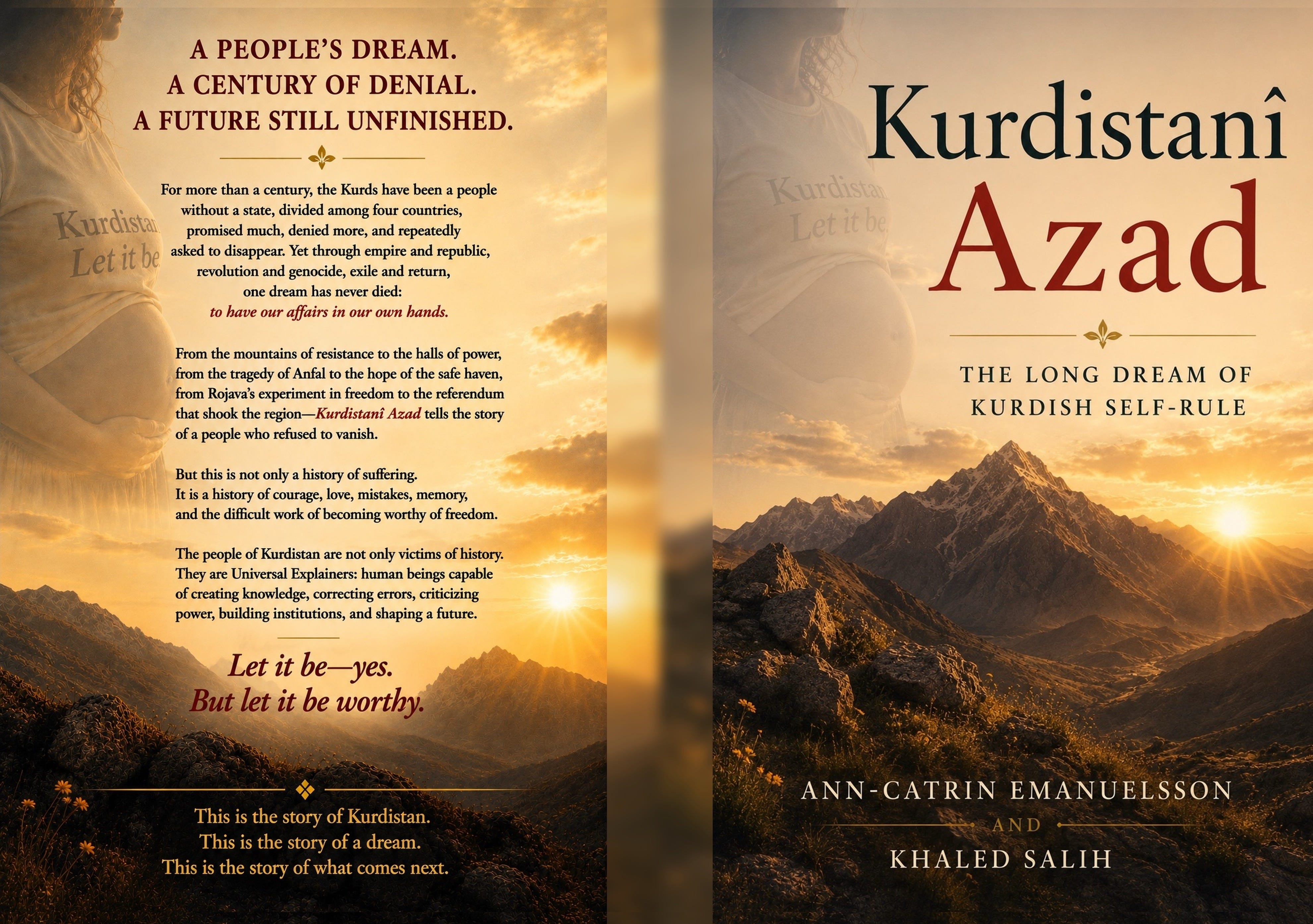
Kurdistanî Azad: The Long Dream of Kurdish Self-Rule continues, a vital text for anyone who claims to fight for justice in the Middle East. Her minorities are under threat and it is our mission to bring their situation to the world’s attention. Find out about the expert authors here.
In Chapter 8, “Revolution as a Language of Hope,” we learnt about the dignity of resistance. It showed why revolution can become necessary in a world where ordinary politics is closed. For many Kurds, armed movements were not born from impatience but from accumulated denial. They emerged because states had made peaceful correction nearly impossible.
Then, in Chapter 9, “My Allâh, Your Punishment,” we moved into the moral and psychological terrain of power, humiliation, fear, and revenge. We asked what kind of world is created when domination is not only military or administrative, but also existential: when punishment enters memory, faith, family, and the inner language of survival.
Today, in Chapter 10 (“The Nightmare”), we bring the reader to the darkest consequences of this history. The Kurdish dream was not only opposed by state policy. It was pursued by systems willing to destroy villages, bodies, names, landscapes, and futures. The nightmare is what happens when a state stops seeing a people as citizens to be governed and begins treating them as an obstacle to be removed.
As with all our book serialisations, this one is a benefit for paid subscribers. So click the subscribe button to read more about the Kurdish situation in Iraq. - Daniel CS (editor)
Khaled and Ann-Catrin get cited here:

Why does The Guerre and Shalom Publishing House need to exist? Read these pieces to find out:


Kurdistanî Azad: The Long Dream of Kurdish Self-Rule
by Ann-Catrin Emanuelsson & Khaled Salih
Parts I & II can be found here.
Part III — The Age of Armed Movements
Chapter 8: Revolution as a Language of Hope

Chapter 9: My Allâh, Your Punishment
Chapter 10: The Nightmare
Anfal, Helebje, Arabization, genocide and the destruction of repair
There are moments in a people’s history when ordinary political language fails.
In this chapter we present a limited claim: Anfal and Helebje were not only extreme acts of state violence; they were attacks on the conditions through which Kurdish life could continue, return, remember, testify, and repair itself. The nightmare was therefore not only death. It was the organized destruction of repair.
This is exterminatory fungibility. The Kurdish person is made interchangeable with an enemy category. The village becomes insurgent space. The child becomes future danger. The mother becomes reproduction of the enemy. The field becomes guerrilla support. The language becomes disloyalty. The mountain becomes military terrain. The family becomes a unit to be moved, counted, disappeared, or destroyed. Genocide begins when a state no longer sees persons, homes, villages, and memories as realities to answer, but as replaceable elements inside a category marked for removal.
Repression, discrimination, betrayal, broken promises, forced assimilation — these words still belong to the vocabulary of politics. They describe states that deny rights, crush dissent, manipulate borders, imprison leaders, and silence memory. But Anfal requires a darker vocabulary. It was not merely repression. It was not merely counterinsurgency. It was not merely war against guerrillas. It was the organized attempt by the Iraqi Ba‘thist state to destroy the social, geographic, and biological foundations of Kurdish life in large parts of Kurdistan in Iraq.
Anfal: Genocide as State Method
Anfal was the moment when Kurdish land and Kurdish life became a killing field.
The name itself was borrowed from Islamic scripture. Anfal is the title of the eighth sura of the Qur’an, often translated as “the spoils of war.” Saddam Hussein’s regime used the name for its campaign against the Kurds in 1988. The choice of name mattered. The regime was secular Ba‘thist in ideology, but it had no hesitation borrowing religious language when useful. The point is not that ordinary Muslim faith led to Anfal, but that the regime instrumentalized sacred vocabulary to moralize state violence. The word gave the operation a civilizational and punitive aura. It suggested that the Kurdish countryside was not merely rebellious territory, but enemy property to be seized, cleansed, redistributed, or destroyed.

Continue reading this post for free, courtesy of Daniel Clarke-Serret.
 | A guest post by
|