



Kurdistanî Azad: The Long Dream of Kurdish Self-Rule continues, a vital text for anyone who claims to fight for justice in the Middle East. Her minorities are under threat and it is our mission to bring their situation to the world’s attention. Find out about the expert authors here.
In Chapter 8, “Revolution as a Language of Hope,” we learnt about the dignity of resistance. It showed why revolution can become necessary in a world where ordinary politics is closed. For many Kurds, armed movements were not born from impatience but from accumulated denial. They emerged because states had made peaceful correction nearly impossible.
Today, in Chapter 9, “My Allâh, Your Punishment,” we move into the moral and psychological terrain of power, humiliation, fear, and revenge. We ask what kind of world is created when domination is not only military or administrative, but also existential: when punishment enters memory, faith, family, and the inner language of survival.
As with all our book serialisations, this one is a benefit for paid subscribers. So click the subscribe button to read more about the Kurdish situation in Iran. - Daniel CS (editor)
Yesterday, the Guerre and Shalom Publishing House published the final chapter of Michelin-Starred Chef Richard Neat’s philosophical memoir. Available for paid subscribers here:

Why does The Guerre and Shalom Publishing House need to exist? Find out my thoughts on “The Cultural Gatekeepers” here:

Kurdistanî Azad: The Long Dream of Kurdish Self-Rule
by Ann-Catrin Emanuelsson & Khaled Salih
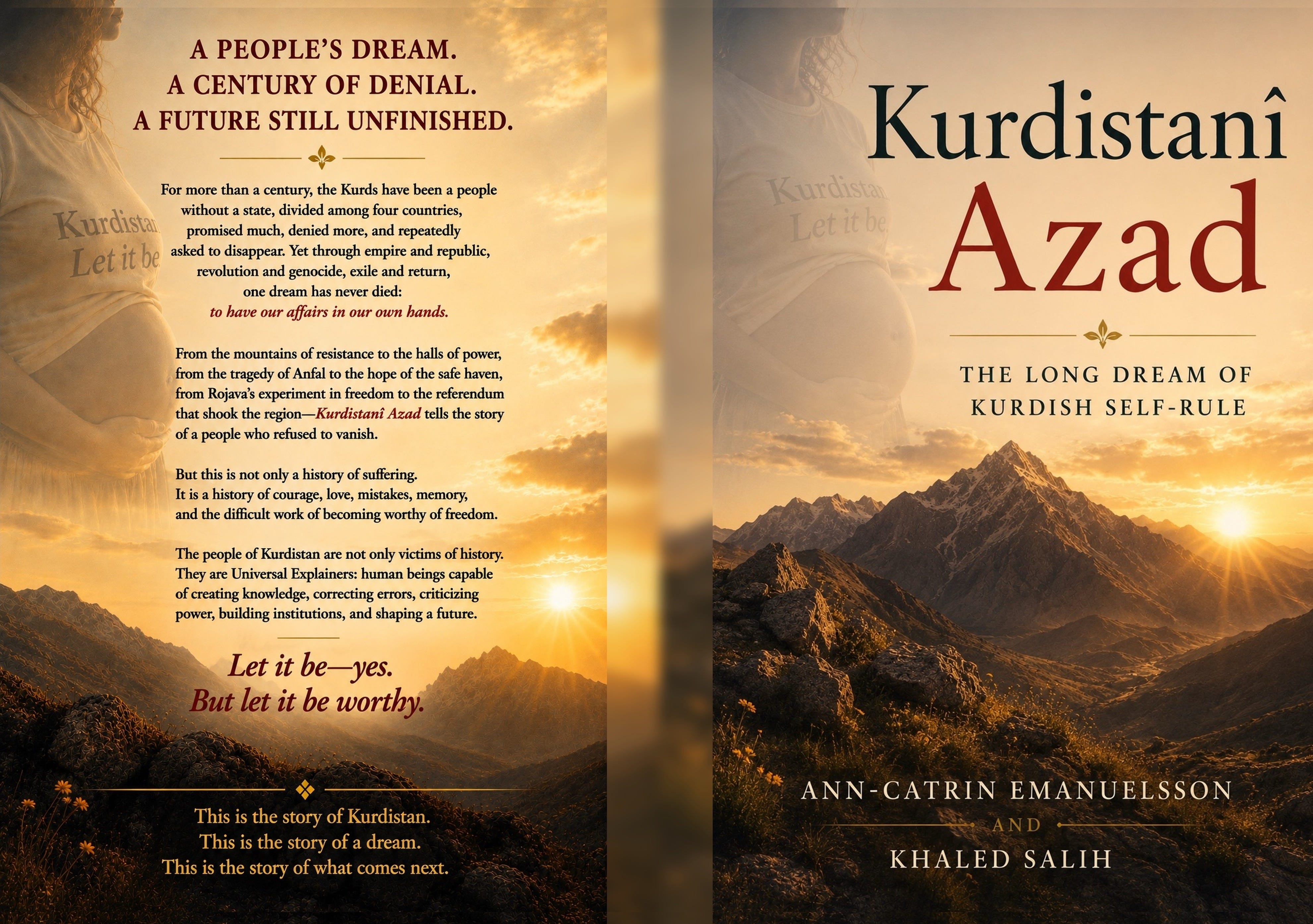
Parts I & II can be found here.
Part III — The Age of Armed Movements
Chapter 8: Revolution as a Language of Hope

Chapter 9: My Allâh, Your Punishment
In the name of religion, the Islamist regime demanded submission. In the name of survival, the Kurds refused disappearance.
The Iranian Revolution of 1979 appeared, for a brief moment, to reopen history.
This chapter is not about private Muslim faith, Kurdish piety, or the ordinary religious life of families. It is about what happens when a state claims sacred authority for itself and turns political disagreement into punishment in the name of Allâh.
This chapter argues a limited claim: after 1979, the Kurdish demand for self-rule in Iran was not merely rejected as a political challenge; it was increasingly moralized as rebellion against revolution, Islam, national unity, and sacred authority. That moralization made correction harder, because disagreement could be punished as impiety, treason, corruption, or a crime against Allâh rather than answered as politics.
The Shah had fallen. The monarchy that had centralized power, suppressed dissent, Persianized the state, and treated Kurdish autonomy as a danger was gone. Prisons opened. Exiles returned. Parties resurfaced. Newspapers multiplied. Students, workers, clerics, liberals, Islamists, Marxists, nationalists, and minorities all believed that a new political order might be possible. For the Kurds of eastern Kurdistan — Rojhelat — this was not merely a change of regime in Tehran. It was the return of an old question: could Iran finally become a state of its peoples rather than a state ruling over its peoples?
1979 as Opening, Not Yet as State
Why believe this time might be different? Because 1979 first appeared not as a completed state, but as an opening. The Shah had fallen. The army was shaken. Prisons opened. Exiles returned. The new centre had not yet fully armed itself with law, constitution, army, and revolutionary legitimacy. Kurdish leaders were not forgetting Mehabad or earlier betrayals. They were testing whether the revolution could be corrected before it hardened into another centralizing state.
The proof of the chapter lies in what happened as that opening hardened: revolutionary promise became state command, and Kurdish correction was redescribed as sacred danger.
The Islamic Republic was born with a different theory of authority.
It did not replace monarchy with plural democracy. It replaced royal centralization with revolutionary-theocratic centralization. The Shah had claimed the authority of crown, nation, modernization, and Persian state continuity. The Islamist Republic claimed the authority of revolution, Islam, martyrdom, anti-imperialism, and clerical guardianship. The vocabulary changed, but the Kurdish structural position did not. Once again, Kurds faced a center that demanded obedience before recognition.
This is the bitter irony of 1979: a revolution made in the name of the oppressed quickly discovered new internal enemies and became the new oppressor. Its language of justice was not empty to those who had suffered under the Shah, but it became selective when non-Persian and non-Shi‘i peoples asked to share power.

Continue reading this post for free, courtesy of Daniel Clarke-Serret.
 | A guest post by
|