

Bring Back Monasticism!
On universities: A reaffirmation of patronage and secluded learning

A Salvation Policy for the Rich
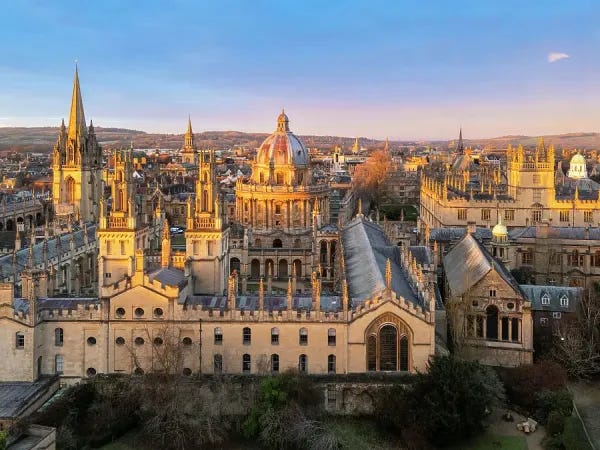
There's nothing like an Oxford stroll to soothe the soul; the dreaming spires, majestic chapels and Gothic architecture all conspiring to lift one's eyes towards heaven. One is reminded of the distinction between two realms, one material, one spiritual, and of the ancient urge to ascend beyond one's physical limitations.
Each step around those august colleges reminds us of a monastic past that is no more. The gatehouses, cloisters and awe-inspiring houses of God; each place us in the holy shoes of our Benedictine forebears. Yet it isn't merely the architecture that whispers a cool medieval breeze, nor the counterpoint of a reclusive place of study in the midst of a working population. It is the silence of learning; the separation between a world of gain and a world of pure knowledge. It is the space that has been made for well-ordered leisure. Beyond the hubbub of a world in motion, a hallowed plane of meditative progress is carved out for the scholarly few.
But who has financed this reclusion from profit? Previously, and even now to a very great extent, it is the wealthy that patronize these institutions. Those that have gone out in the world to gain riches and accumulate power give something back to the community that made them. In acts of regular philanthropy, they give their names and hard-earned pounds so that others may be shielded from the evils of society beyond.
What motivates this philanthropy? Is it rationality or is it guilt? At the apogee of monasticism, it was surely the latter. The Medieval World presented a reality of violence and constant killing. No King, no matter how well-meaning or devoted to God, could escape the vicious cycle of bloodshed. To get ahead and to stay ahead, there was only one way: to be more brutal than your adversaries; to be more warlike than your foes.
The New Testament taught of pacifism and meekness. It spoke of the rich giving away their wealth and the powerful proceeding swordless. Yet it was an idealism that even the most sincere Christian Monarch could ill-afford. To act thus would be to write one's own death warrant.
And so it was that the monastery and worldly laity acted in a state of symbiosis. With the extra-monastic people racking up sins at an ungodly rate, they urgently needed the spiritual reserves being built up by their cloistered cousins. The ascetics beyond the monastery walls were going above and beyond. Having consented to chastity, poverty, communal prayer and lack of sleep, they had truly entered the kingdom of God. The material reality long discarded, they had been given the space to grow spiritually, so much so that they were overflowing with good deeds. By donating to the local monastery, the rich and powerful were buying their future salvation.
Discipline over Renunciation. Wealth over Poverty.
The contradiction of this continual patronage is plain to see, for what is the motivation of monastic living? Surely it is to escape from the world. Surely it is to leave material reality to ascend to ivory towers. But the more they withdrew themselves; the more they were attractive to a sinful ruling class in need of a Salvation Policy; the more they were subject to ever more lavish donations. Far from being viewed as layabouts, a work-shy class in need of condemnation, the monkish minority were seen as essential to the maintenance of a Christian society.
It was all a far cry from the beginning of asceticism. In those halcyon days on the banks of the Nile, the lonely Saint dwelt alone in the desert, depriving himself of everyday necessities in order to mimic Christ's confrontation with the Devil. It was a notoriously tough existence, achievable only by those with an unquenchable desire for spiritual perfection. Perhaps the most famous of these hermits was Simeon the Stylite who, in an act of endurance never yet equaled, lived 36 years on top of a tiny Syrian platform. An existence not for the faint-hearted.
Come the Middle Ages, however, monasticism provided a less demanding route to the Kingdom of God. The exigencies were still great, but the funding was fabulous. None would go hungry, and in an era of great want, the monkish class could live without fear of squalor; unremitting patronage making it so. By the time of the Reformation, the monastic pool of wealth was so great that opponents of Catholicism cried foul.
We must not understate the commitment of monastic vows. Individual desires were subsumed by collective discipline. Under the Rule of St Benedict, there were 12 merciless steps to humility: They were fear of God, self-denial, obedience, perseverance, repentance, serenity, self-abasement, prudence, silence, dignity, discretion and reverence. Rather amusingly restated by Father Wetta, these can be described as:
“Be afraid, don't be true to yourself, don't follow your dreams, suffer fools gladly, put your worst foot forward, be someone's doormat, have a poor self-image, think inside the box, don't speak up, laughter is not the best medicine, don't be the life of the party and keep your chin down.”
Nonetheless, the challenge was (and is) less renunciation and more obedience. At every moment of your waking day, your routine is determined by an authority figure: when you rise, when you pray, when you eat and when you slumber, you are no longer the master of your own ship. You are a highly disciplined servant of your abbot-shaped master. In return for generous patronage, you consent to submission.
The Roots of Liberal Learning
Initially, routine was placed on a pedestal above learning. In the writings of St Benedict, we do see references to reading, but it is implied that it is an act of work - even punishment - more than a commitment to growing and protecting the knowledge of society. Nonetheless, with time, the monastery became the sole repository of classical wisdom.
It was here that literacy flourished and books were lovingly copied. It was here that education was placed front and centre of the Carolingian educational revolution. It was even here that the liberal arts blossomed. In the person of the 6th Century Roman monk Cassiodorus, the 7 elements of a liberal education were reconciled with Christian thought, protecting the classical legacy until modern times.
At first glance, the connection between monastic living and liberal learning can be hard to fathom. Surely, one might think, an Orthodox Christian would have limited horizons. They would see the Bible as the only source of knowledge and look paternalistically on the classical legacy of a pagan society. But this is to misunderstand the full implications of a religious life. Even if one were to limit one's imagination to the four walls of scripture, there is plenty that one is still committed to learn.
For example, how is the learning monk to identify the date of Easter? Mysteriously calculated using a combination of the lunar and solar calendars, the literate believer is called upon to study astronomy and thoroughly imbibe principles of mathematics. As time went on, the sciences were seen as an accompaniment, not an adversary, to the religious disposition. Through discovering the secrets of the universe, one could gain an insight into the perfection of the mind of God.
Yet beyond knowledge for knowledge’s sake, the monastic life called for the advancement of practical learning. As the patronage for monasteries became ever more generous, so did the resulting architecture. Cloisters, chapter houses, refectories, graceful classical columns: all these required the creative skills of architects and tradesmen.
Monks needed books for daily prayer, grace before meals and administration. The painstaking copying of texts became part of their stock-in-trade. In the process, art became ever more sophisticated, with beautiful illustrations adorning the margins of lovingly compiled volumes.
And let us not forget music. Singing was an essential element of monkish daily life. Choral compositions conceived, melodies were then notated upon musical scores. Thus learning was safeguarded, developed and transmitted through the monastic system. Through the unlikely method of disciplined leisure, nurtured far from the Madding Crowd, the men in brown habits became the vessels of human knowledge.
Emergence of the University
Monasteries are still with us today, but they have long since ceased to be at the beating heart of a political community. The rich and the powerful have turned to another method to alleviate their sins: the modern University. Once they have waxed fat on excess profit and adjusted the tax rate to the liking of themselves and their peers, it is to the great cloistered universities that they direct their philanthropy.
The coffers of Harvard University are piled high with the banknotes of the guilty; the generations who have shorted the market and turn to our scholars for redemption. These in turn have funded ever more luxurious projects. American universities, in particular, spend inordinate amounts of money on unused libraries, luxurious stadia for American football and the very best in sports coaching. None of this excess benefits the learning of its students, its scholars or society as a whole. It is the sign of an industry in need of Reformation.
The university has always been modeled on its monastic predecessors and not only in terms of architecture. The curriculum too follows the model of her ancestors. Let us give the example of Oxford University, the oldest institution of its type in the English-speaking world.
The University began to develop in the reign of King Henry II who, for reasons of administration, needed scholars trained in law. The curriculum was firmly based on the liberal arts already articulated. From logic to grammar to music, the legacy of Ancient Greece via monasticism reverberated throughout its solemn walls, newly fortified to protect the scholars from the angry local mob.
Furthermore, the presence of castle-like colleges secluded the scholarly class from the outside world. As with their religious cousins, they could finally discard the worldly to concentrate on what was more important in life and they were patronized for this purpose by the King and other wealthy subjects.
To be clear: Colleges were built by monarchs to pray for their souls. Learning was financed with a view to salvation.
Bring Back Monasticism!
These are lessons that we would do well to internalize when considering the role of the modern university. Despite the brickbats thrown at profiteers in preceding paragraphs, I will happily acknowledge the positive influences of post-industrial capitalism. It is capitalism that has dragged hundreds of millions of Chinese from poverty to middle class comfort. It is capitalism that has been a fuel for innovation, responding to the wants and needs of consumers.
But capitalism is also dirty; a necessary evil, needed and without sensible alternatives, but dirty nonetheless. The search for ever greater profit degrades the soul, notwithstanding that it is accompanied by an invisible hand.
As everybody knows, including Leonard Cohen, the rich get richer, the poor get poorer and guilty get guiltier, at least in relative terms. We do need a market economy - let us be clear; just as in medieval times where brutal leadership was needed to keep society cohesive. Yet such degrading “dirty work that someone has to do” leaves the wealthy with the internal need - and duty - to give something back. In past times, they would have generously patronized monasteries. Today, they give to universities. So the question is: are the universities doing enough to save their souls?
The modern-day professor wishes to live like an early Middle Age monastic aesthetic. They seek guided leisure which leads them to learning and scholarship. And why do they chose the scholarly life? To escape society in order to improve it, not to be drawn into its monetary clutches.
Walking carelessly around those cloisters, they wish to think, reflect, teach and, when the inspiration takes them, write. They seek neither monetary gain nor monetary pressure, for as with the monkish class before them, innovation will proceed naturally.
When the monks sang, they developed music. When they copied texts, they developed art. When they longed for Easter, they applied Mathematics. They didn't need the insatiable writing demands of an abbot-cum-university chancellor to motivate them. Their solitude was its own motivation.
This was why they received the patronage of the rich, powerful and guilty; because the dirty hands of the world needed the accumulated benefits of learning.
So let us allow our scholars to be scholars. Don't tell them they need to write 100 articles a year or non-stop best-selling books. Don't give them targets and conditional wages in the vain hope of tenure! And most certain of all, don't wipe their face in the mud by building vanity projects and white elephants; all at the cost of spiralling student fees and disappearing, talented scholarship. Just let them be! Just let them stroll and sit wistfully on rocks!
Our CEOs are not patronising Yale because they want the professorship to be yet another business. It's because they want their souls to be served by the development of collective learning. So let our scholars do their “job” — seclusion from the world for the benefit of the world. Pure learning so that we may all ascend to the Ivory Towers of spirituality.
The aesthetic life is a deprivation. It is giving up on riches to elevate the soul — and to improve our global community in turn. It is disciplined scholarship, once patronized by bloody Kings and unscrupulous nobles for a place in heaven.
Today we need that attitude once more. The wealthy are still patronising places of learning and the scholars still wish to learn, but university chancellors are becoming pre-Lutheran abbots fat on the wealth of patronage.
What we need is Reformation: Continued patronage, continued learning, but University Chancellors allowing scholars to develop unmolested by profit. And the same goes for talented Substack authors in need of patronage! For only then will society ascend to greater heights with learning safeguarded for the next generation.
Bring back monasticism now!
Patronise Guerre and Shalom with a paid subscription.

