
A Revolt without a Historian
A Lag Ba'Omer Special


We all know about The Great Revolt of 70 CE because Josephus was on hand to scribe the fateful events. Far less is known about the Bar Kochba uprising. It is shrouded in myth, for it was, in Rabbi Kavon’s words, “A Revolt without a Historian”. Hopefully today’s article will shed some light on the matter. - Daniel Clarke-Serret (editor)
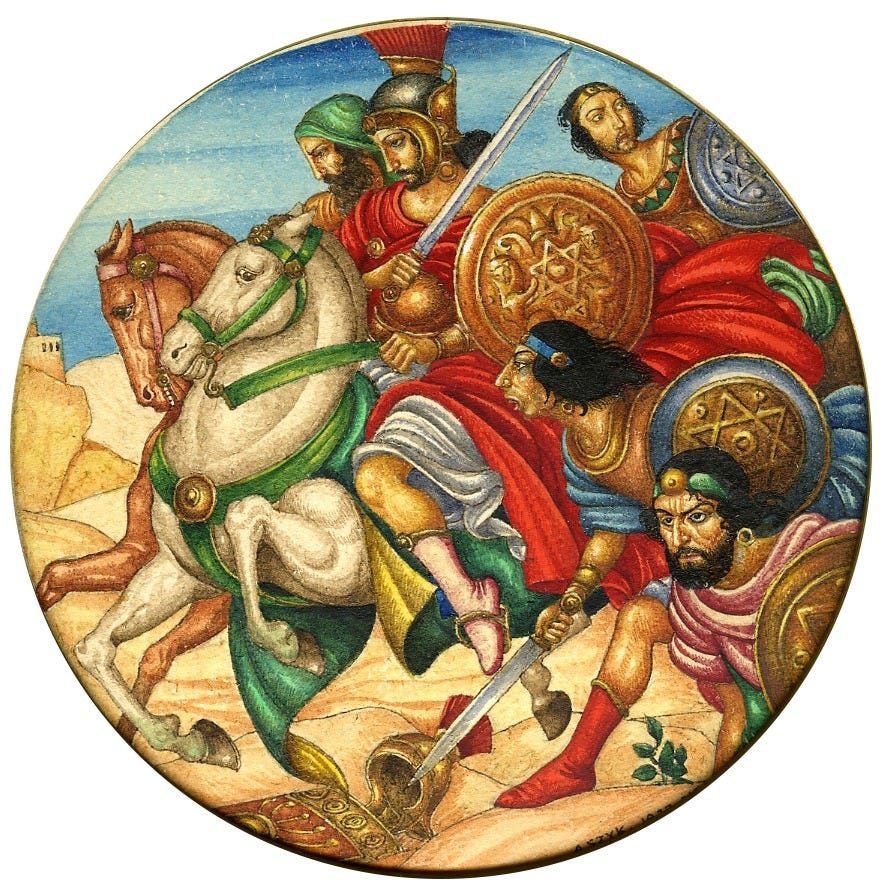
Yigael Yadin’s discovery in 1961 of the letters of Bar Kochba in a cave near Ein Gedi electrified the Jewish world. The archaeologist—a statesman and military leader—unearthed the documents and other artifacts from the Jewish rebellion against the Roman Empire in 132-135 in the Land of Israel. The letters Yadin discovered were invaluable: the paucity of historical accounts, especially by eyewitnesses, hampered any attempt to discover the secrets of the successes of Shimeon Bar Kosiba and his rebels who fought Rome’s best legions for two years. Archaeology proved invaluable in reconstructing the events of a battle against overwhelming odds that ended in defeat at the Judean stronghold of Beitar.
Had Yadin not discovered the letters, we would have had to rely on the ancient Roman historian Cassisus Dio, Church Father Eusebius, and Talmudic aggadah for the story of the rebellion. That would have been inadequate. Unlike the Jewish revolt against Rome sixty years earlier, there was no Josephus to write an insider’s account of the struggle. Yosef ben Mattityahu—at first the leader of Jewish forces in the Galilee who later betrayed the rebellion by siding with the enemy—wrote The Jewish War as Josephus Flavius a decade after that revolt was crushed. While his Flavian Roman patrons expected Josephus to write a chronicle sympathetic to Rome, many of the details of the 66-73 revolt can be trusted. Far from being a turncoat, Josephus was a master polemicist in defense of Judaism in the pagan world. His genius would have illuminated the later revolt, had he not died decades earlier.
That leaves us with Roman historian and statesman Cassius Dio. Writing almost a century after the Bar Kokhba revolt, Cassius Dio’s account of the revolt indicates that the Jewish forces arrayed against Rome were formidable and that the empire had struggled to destroy the rebels. He begins his account with the reason for the rebellion. Emperor Hadrian converted Jerusalem into a pagan city, naming it Aelia Capitolina.
On the site of the destroyed Jewish Temple he raised new temple to Jupiter. Writes the historian, “This brought on a war of no slight importance nor of brief duration, for the Jews deemed it intolerable that foreign races should be settled in their city and foreign religious rites practiced there.” Initially, the Romans “took no account” of the rebels. But as the Roman forces were defeated in battle after battle, Hadrian brought in Julius Severus, one of his best generals, who led the fierce legions and brought them from Britain to fight the Jews. Rome was successful. Judea was devastated.
While the Roman forces destroyed the revolt, it was at a high cost. Cassisus Dio describes Hadrian lauding the victors but his decree to the senate is telling, “If you and the children are in health; it is well. I and the legions are in health.” The memory of this omission is so stark that Cassius Dio, born twenty years after the revolt was crushed, included it in his history.
While this pagan source is important and provides some critical information, it is no way comprehensive, even leaving out the name of Bar Kosiba or Bar Kochba, the rebels’ leader. Also, the details of the battles of the revolt are omitted. That is a shame. Church Father Eusebius, writing in the fourth century, adds little detail of the rebellion, but he does mention Bar Kochba. But this is a brief reference, part of a larger anti-Jewish polemic and does not add much to our understanding of the revolt.
We are left with Jewish sources in the Talmud that do not fill this void and, for the most part, are hostile to Bar Kochba. I will give just one example from this Jewish source.
Rabbi Akiba, the greatest mystic and legal mind of his epoch, believed Bar Kosiba was the Messiah who would drive the Romans out of the Land of Israel and would rebuild the Temple in Jerusalem. The illustrious rabbi referred to the revolt’s leader as “Bar Kochba,” a reference to the biblical verse “A star (“kochav” in Hebrew) shall step forth from Jacob.” This star was interpreted as “King Messiah.”
But not all, if most, of the rabbinic leadership agreed with Akiba. Bar Kosiba was referred to by them as Ben “Koziva,” the son of a kozev, in Hebrew “a liar.” Rabbi Yochanan ben Torta said to Akiba that “grass will rise from your cheeks and the son of David will not yet have come.” We have to treat Talmudic and Midrashic sources carefully. They dominated the negative rabbinic view of Bar Kochba until the rise of a modern Jewish State in the 20th century, But Modern Zionism didn’t seem to be interested in a Bar Kochba free from myth either
That is why Yadin’s discovery of Ben Kosiba’s letters is so important. They grant us insight into the inner workings of the rebellion. The letters are either written in Hebrew or Aramaic to Bar Kosiba’s subordinates. He does not use the name “Bar Kochba, the King Messiah”—instead he signs the orders from “Shimeon bar/ben Kosiba, Nasi.” The latter word is a neutral term for “President” or “Prince”—a political and military leader. Did Bar Kosiba agree with Rabbi Akiba’s assessment of him as the Messiah? It seems not.
Morris B. Margolies in Twenty Twenty: Jewish Visionaries Through Two Thousand Years (2000) states that Bar Kosiba’s letters to subordinates in Ein-Gedi “are abrupt and to the point. Their sender is clearly not a person to be fooled with. He orders specified provisions to be sent to him without delay, on pain of punishment. He orders the confiscation of wheat held by a prosperous farmer. He commands the incarceration of ‘all men from Tekoa’ to be sent to him under guard. He orders the arrest of one Eleazar bar Hitta, a wealthy landowner of En-Gedi who failed to comply with previous orders of the supreme commander.” Bar Kosiba’s success was rooted in strict discipline and unquestionable obeying of orders.
One letter found by Yadin is a request by the Nasi for the Four Species waved on Sukkot. They were to be tithed. Obviously, Bar Kokhba was not the portrait painted today of a secular hero from a secular kibbutz. He was a Jew who fulfilled Torah law.
There is also numismatic evidence of the rebellion. An important part of archaeological discoveries is coins minted during the revolt celebrating Jewish sovereignty and these coins attest to the success of the rebellion, certainly during the first two years. If only a fighter for Bar Kokhba would have been able to write an eyewitness account, we would then know far more of the events, strategy, and personality of the later rebellion.
The Bar Kochba revolt, celebrated on Lag B’Omer, remembers the last Jewish sovereign state in the Land of Israel before 1948. So let us delve into the real “Bar Kochba”—Shimeon Bar Kosiba—and move beyond the myth that has been cultivated about this remarkable leader. In the absence of a Josephus in 132 CE, we should investigate the evidence that remains. Only then will we be able to understand the nature of a revolt that lacked a Jewish historian.
Subscribe as PAID today to gain full access to Daniel Clarke-Serret’s PAX ARABICA.
“An important work” (Einat Wilf, The War of Return)
“The book represents writing and thinking of the highest calibre —a testament to intellectual courage. Daniel offers a sweeping and meticulously argued indictment of Arabized Islam as an imperial force. Colonialism has, for too long, been regarded as a uniquely Western sin and something in which only nations engage. Daniel shows that Arabized Islam itself, whether secularized or more overtly religious, is history’s greatest colonial and expansionist force.” (Nachum Kaplan, Moral Clarity)
“Most books about the Middle East try to sound reasonable. Pax Arabica tries to be accurate. … Clarke-Serret’s core contribution is a reframing. Shifting the conversation from a cartoon land dispute to a civilizational and imperial conflict over sovereignty, identity, and the right of minorities to remain alive. He takes the reader through the region’s suppressed record—minorities erased, words inverted, violence excused—and he does it with a thesis strong enough to argue with.
Clarke-Serret’s bet is simple and unfashionable. Truth exists. Words have meaning. Minorities deserve to live. That includes—especially includes—the indigenous peoples the Arabising whirlwind tried hard to erase. If the West keeps laundering conquest with corrupted terms, it will keep rewarding the strong and sacrificing the weak. Pax Arabica is a refusal to participate in that fraud” (Uri Zehavi, Rooted Truth).
“Daniel Clarke-Serret's Pax Arabica deserves to be required reading in the Middle East Studies Departments in all universities. The author's knowledge and his power of original thought emerge in each page of this study of "Arab Colonialism." From Isaiah to Abu Bakr to Kant to Washington to Sayyid Qutb--this book is thoughtful and panoramic, ripping away the lie that all Arabs are victims of "European Colonialism." Instead, the author makes clear that "Arab Imperialism" has been a "Babel" that demands totalitarian and religious uniformity, negating the rights of minorities and demanding conformity. Kudos to "Daniel Clarke-Serret on a serious investigation of a topic that can no longer be neglected.” (Rabbi Eli Kavon)
“In its brutal and brilliant diagnosis, Pax Arabica presents an intellectual framework that is nothing less than a controlled demolition of the West’s entire understanding of the Middle East. It unmasks the Arab Imperium as the region’s true colonial power, deconstructs its sophisticated weapons of narrative warfare, and indicts decades of Western appeasement as the product of moral cowardice and philosophical bankruptcy.” (Khaled Salih, Senior Kurdish Academic and Political Advisor)
“Congratulations to Daniel Clarke-Serret for his Pax Arabica series. Informative, well researched and a really appealing prose style. I’ve found myself quoting passages from the chapters as the topics covered are, as always, very much in the news. Again, well done for such a great work.” (Richard Neat, Observations from the Kitchen)
“Important writing - especially polemical writing - is not judged by some standard of uncontested correctness but by its uncontestable moral courage and its argument grounded in and faithful to principle. On this score, Daniel Clarke-Serret’s Pax Arabica is worthy of high praise. It deserves to be read carefully and taken seriously. Make up your own mind about Clarke-Serret’s conclusions. But do not dismiss the importance and the incisiveness of his critique of some of our age’s dominant - and most pernicious - cultural and historical narratives.” (Peter L Biro, The Notwithstanding Clause and the Canadian Charter: Rights, Reforms, and Controversies)
“There are plenty of ferocious and polemical defenses of Pax Arabica by innumerable apologists for imperialism and terrorism like Edward Said and Rashid Khalidi. A ferocious and polemical response to them is long overdue. In writing one, Clarke-Serret is stronger in history and logic than the apologists, and certainly possesses a moral clarity and historical accuracy they would never dare embrace. More than anything else, however, Clarke-Serret states a simple but too often silent truth: Morality is reciprocity. If the West must face history and itself, so must everybody else. As long as the partisans of Arab imperialism do not, no one in the West is obligated to listen to a single word they say.” (Benjamin Kerstein, Self Defense: A Jewish Manifesto)
“Daniel Clarke-Serret is one of the rare voices who insists on addressing the unwanted, the forgotten and the silenced. In Pax Arabica, he lays all before us—a discovery, a revelation in the truest sense. Truth is unveiled, falsehoods are exposed and lies are uncovered. Only thus can hope be seen clearly, with all its bitterness and all its sweetness.” (Dr Lothar Riemenschneider)
“The Arab Empire is invisible —an insidious entity that can’t be seen with the naked eye. This is the astonishing opening claim of a book which is a must-read. Pax Arabica is a seminal work and one which all readers are strongly encouraged to buy!” (Noah Otte)
“In an existential crisis, such as we are in now, we cannot afford to be blind to what is really going on. As Pax Arabica shows, much of what passes off as conventional ‘wisdom’ about Islam, Palestine, Arab history and colonization is not based on evidence or clear thinking.” (Ashok Panikkar, Ten Lies that Killed Democracy)
“I wanted to extend my sincere congratulations on the publication of Pax Arabica. I have long admired your thoughtful and insightful writings, and am reading, with interest, the wonderful reviews provided by some of the top authorities in the field. Wishing you great success with this significant achievement.” (Ruth Sheridan)
“If you haven’t read this brilliant book by Daniel Clarke-Serret yet, you’re missing out on important information. Great talking points for dialogue and discussions with people who don’t understand the Middle East and Arab colonization.” (Miller Canning)
“Pax Arabica illuminates the situation in the Middle East ignored by mainstream media and academia. Not only does it delve into the Israel-Palestine conflict, it also explains the minority situations within the Arab and Muslim world.” (Michael Constan)
Have you read PAX ARABICA?
Subscribe as paid to Guerre and Shalom today.

 | A guest post by
|
Another great article from Daniel Clark-Serret.